Tailored Sealing System For Refrigerant Line Penetrations In Precast Insulated Walls
Data center wall penetration sealing made easy: airtight, watertight, and thermal-efficient solutions for complex refrigerant line layouts.

BACKGROUND
A major Tier III data center in the Midwest faced a complex sealing challenge involving its mechanical system. As part of the facility’s climate control infrastructure, dozens of copper refrigerant lines, ranging from 1/4” to 1-5/8” in diameter, needed to pass through rectangular openings in precast insulated wall panels. These penetrations varied widely in density, with as few as 4 and as many as 24 lines routed through a single opening. Due to the critical nature of the equipment and the importance of preserving the building envelope, these penetrations needed to be sealed against air, water, and thermal leakage. The seal also had to be adaptable to irregular pipe layouts and tight installation timelines.
CHALLENGE
The project presented several technical challenges. The round copper pipes were passing through rectangular wall openings, creating irregular geometries that were difficult to seal using
conventional methods. The varying number of lines per penetration made a one-size-fits-all approach unfeasible. Additionally, because the lines included both liquid and suction pipes,
maintaining a vapor-tight and watertight seal was essential to prevent condensation, thermal bridging, and energy loss. Beyond performance, the sealing solution needed to install cleanly and
quickly in a construction environment with limited clearance and minimal tolerance for error. Standard sealing products lacked the flexibility and modularity required for this type of configuration.
SOLUTION
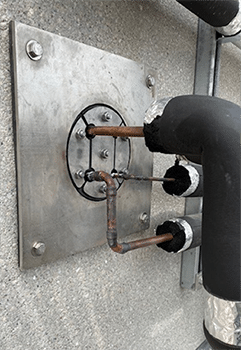 Recognizing the limitations of traditional methods, the contractor partnered with Polywater to develop a modular, multi-diameter sealing solution tailored to the specific layout of the refrigerant piping. The final system was a customized solution from Polywater | Hauff-Technik which included:
- Stainless-steel flanges fitted to the rectangular wall openings and anchored to both the exterior and interior of the precast walls
- Exterior flanges with integrated wall sleeves extending through the insulated cavity to protect against condensation.
- Custom one-piece PHRD seals made of EPDM rubber and stainless steel that were precision-cut to match the diameter of each copper pipe. This type of seal was selected for its flexibility and tight-sealing performance.
The hinged, one-piece seals could be installed after the pipes were already in place, eliminating the need for rerouting or disassembly. A mechanical compression system ensured uniform pressure and long-term sealing integrity. This approach delivered a scalable and reconfigurable solution that could adapt to each unique wall opening while preserving the thermal and moisture performance of the wall system.
IMPLEMENTATION AND RESULTS
Once pipe routing and sleeve dimensions were finalized, the Polywater team quickly delivered a site-specific sealing package. The installation process was straightforward: wall surfaces were prepped, pipes were bundled and secured, and the modular frame and seal components were installed and compressed using torque-controlled hardware. The result was a high-performance seal that met all inspection requirements and exceeded expectations:
Sealing Performance: Achieved airtight and watertight seal to 36 psi
Thermal Protection: No detectable thermal bridging
Installation Efficiency: 60% faster than conventional sealing methods
Maintainability: Modular seals could be reopened and reused for future line additions
Compliance: Passed all mechanical and thermal envelope inspections
CONCLUSION
This project showcases how a tailored sealing solution can transform a difficult wall penetration scenario into a streamlined, code-compliant installation. By leveraging the flexibility and performance of the Polywater | Hauff-Technik modular sealing system, the data center team was able to confidently protect its infrastructure from environmental risk—without compromising on time, complexity, or long-term maintainability. In mission-critical environments, small gaps can create major vulnerabilities. With the right sealing system, even the most complex penetrations can be reliably secured, preserving both the performance and integrity of the building envelope and providing easily maintainable system for future upgrades.
Have any questions?
