Advances in Friction Testing for Ducted Cable Installation
Explore how Polywater is advancing friction testing for ducted cable installation with enhanced Friction Table methods, larger cable testing capabilities, and research-driven lubricant solutions for modern underground cable projects.

Polywater® has been measuring cable friction since we developed our first cable lubricant. For Polywater, this friction research spans a variety of test methods, material development, and cable installation changes. Complex sea cable landings from offshore wind farms to increases in data center energy demands require updated testing and lubrication guidance. To meet these evolving needs, Polywater is dedicated to the continuous improvement of our products and testing protocols to ensure that our partners/customers have the data and tools necessary.
Polywater utilizes many different methods to test friction, from large, outdoor test sites to indoor loops and bends. Throughout all this testing, we always come back to the Friction Table method. The versatility of this test has made this device a cornerstone of our research.
Setting the Standard in Cable Pulling Friction Testing

The Friction Table method was developed over 40 years ago. The first paper was published at the 1984 IEEE Transmission and Distribution conference. This paper examens basic friction theory and the physics concept of an inclined plane test method. It lays out the benefit of a Friction Table test that utilizes a normal force that better replicates cable pulling forces. Because of the low normal force in the inclined test method, the force to overcome the viscous drag of the lubricant is significant. The inclined plane test method is primarily a ranking of lubricant viscosity. The Friction Table method shows better correlation to real cable pulling.
| Related Content: Polywater-Coefficient of Friction Measurement Between Cable and Conduit Surfaces Under Varying Normal Loads |
Versatility of the Friction Table Test Method

| Related Content: Evaluating a Historic Conduit for Upgrade |
The Friction Table utilizes relatively short sections of cable and conduit. This means that a large variety of cable jacket materials and conduits can be tested. Over the years, Polywater has tested hundreds of material combinations. Some of the more interesting studies have involved the installation of new cables into existing conduit systems. This includes a variety of materials from reclaimed, bituminous fiber conduit to untreated steel with mild corrosion. Polywater has always offered this friction testing service to assist with cable installation planning. Years and years of this testing have resulted in a cable database without comparison.
Adapting to Meet the Evolving Needs in Friction Testing
Polywater friction table circa 2007.
| Related Content: Optimizing Cable Installation: The Importance of COF and Material Testing |
Today’s cables are designed to last underground for 40 years or longer. Jackets protect the cable against the environment and are a critical part of maintaining this longevity. The polymers used in the cable are constantly evolving. Cable jackets materials continue to go through development and improvement. Jacket material improvements include new designs for long term performance, improved fire properties, and improved sustainability characteristics. As cable jackets evolve, Polywater continues to test.
The Next Evolution of the Friction Table Test

More high-voltage cables are being installed underground to provide greater protection from environmental conditions and to efficiently navigate complex right-of-way constraints. As a result, larger cables are being pulled through conduit systems, and installation lengths continue to increase. For Polywater, this shift drives the need for expanded testing and ongoing product refinement. In response, we have updated our Friction Table design to accommodate larger cable sizes and more demanding installation conditions.
| Related Content: The Polywater® Friction Table: Personal Perspectives |
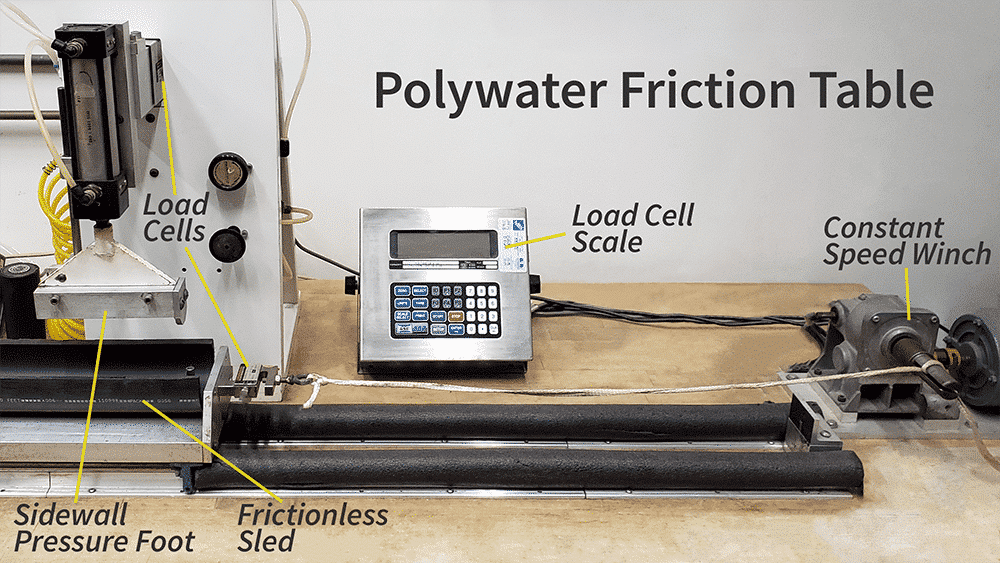
The new, improved Friction Table is more than twice the size of the old unit. The load piston span has been increased by 300%. We can now accommodate cables up to 14 inches (35 cm) in diameter. With the addition of a variable speed winch, we will continue to complete original research such as the effect of pulling speed on COF.
Adapt and Advance with Polywater
For complex cable installations, Polywater offers friction testing to evaluate performance and determine the most effective lubricant solution. As installation requirements evolve, Polywater continues to adapt and advance. Do you have a challenging cable installation? Please contact us.